
What Is Tongue Tie (Ankyloglossia)?
Have you ever noticed that your tongue does not move as freely as it should?
A restricted tongue can sometimes be caused by tongue tie, medically known as ankyloglossia. It occurs when the lingual frenulum, the band of tissue connecting the underside of the tongue to the floor of the mouth, restricts normal tongue movement.
Tongue tie can be present from birth and may vary considerably from person to person. In some people, it causes noticeable functional difficulties, while others may have a tongue tie without requiring any treatment.
When the restriction affects important oral functions, a dental evaluation can help determine whether treatment may be appropriate.
What Causes Tongue Tie?
Ankyloglossia is generally related to the development of the lingual frenulum before birth. The frenulum may be unusually short, thick, tight or positioned in a way that limits tongue movement.
However, the appearance of the frenulum alone does not always determine whether treatment is necessary.
A proper assessment should consider how much the tongue’s movement is restricted and whether the restriction is causing functional problems. Research also shows that there is no single universally accepted classification system or treatment approach for every tongue-tie case.
What Are the Symptoms of Tongue Tie?
The signs of ankyloglossia can differ depending on the person’s age and the severity of the restriction.
Some commonly reported difficulties include:
- Limited ability to lift the tongue
- Difficulty moving the tongue from side to side
- Difficulty sticking the tongue out
- Difficulty touching the upper teeth or palate with the tongue
- A noticeable pulling sensation under the tongue
- Difficulty keeping food particles away from certain areas of the mouth
- Problems with certain oral functions
- Feeding difficulties in some infants
- Speech concerns in some children
A person does not necessarily need treatment simply because a tongue tie is visible. Functional assessment is important before deciding on a procedure.
Can Tongue Tie Affect Speech?
This is one of the most common questions patients and parents ask.
Tongue movement plays an important role in producing many speech sounds. However, the relationship between tongue tie and speech problems is not straightforward.
Current research has not established a clear causal relationship between ankyloglossia and speech disorders in every patient. Studies evaluating speech improvement after tongue-tie release have also produced mixed results.
Therefore, tongue tie should not automatically be considered the cause of a speech difficulty.
If speech is a concern, assessment by the appropriate dental and speech professionals may be recommended before deciding on treatment.
When Does Tongue Tie Need Treatment?
Not every tongue tie requires treatment.
A dentist may consider treatment when the restricted frenulum is associated with meaningful functional difficulties and the benefits of releasing the restriction are expected to outweigh the potential risks.
Depending on the patient’s age and concerns, the evaluation may consider:
- Tongue mobility
- Oral function
- Feeding difficulties
- Speech-related concerns
- Oral hygiene challenges
- Discomfort or functional restriction
- The patient’s overall dental and medical history
The decision should always be individualized rather than based only on how the frenulum looks.
What Is Tongue Tie Release?
Tongue tie release is a procedure performed to reduce the restriction caused by the lingual frenulum.
Depending on the anatomy and clinical requirements, procedures may be described as frenotomy, frenectomy or frenuloplasty. The exact approach depends on factors such as the patient’s age, anatomy, degree of restriction and the treating clinician’s assessment.
The objective is to improve the functional movement of the tongue where the restriction is clinically significant.
For children and adults with symptomatic ankyloglossia, treatment may be considered when conservative management is insufficient or when a clear functional limitation is present.
What Happens During Tongue Tie Release?
The exact procedure varies from patient to patient.
Generally, the dentist first evaluates the tongue and lingual frenulum to determine the extent of restriction. If release is recommended, the restricted tissue is carefully released using an appropriate clinical technique.
In some cases, sutures may be placed to support healing and the shape of the surgical wound.
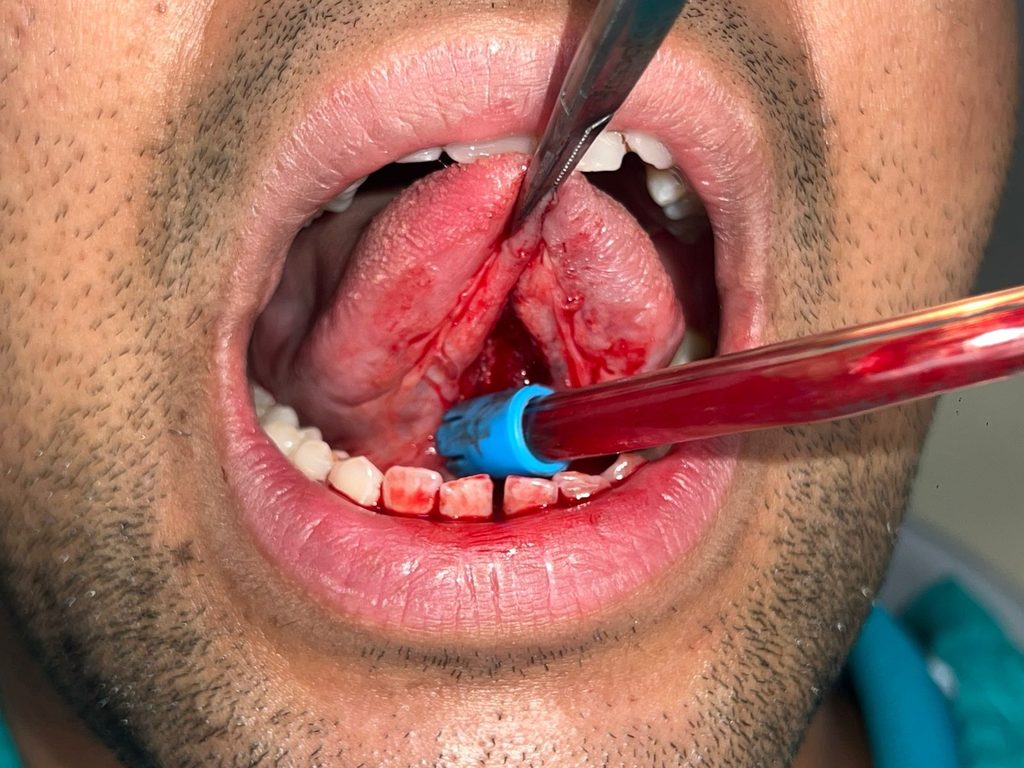
The photographs from a recent case treated at Caring Hands Dental Studio, Greater Noida, demonstrate the clinical stages of a tongue-tie release procedure, including the restricted lingual frenulum and the postoperative sutured area.
Clinical Case: Tongue Tie Release
Before treatment:
The photographs show a restricted lingual frenulum limiting the normal movement of the tongue.
During the procedure:
The restricted tissue is carefully released to improve tongue mobility.
After the release:
The treated area is sutured as part of the procedure and postoperative healing begins.
Clinical note: Individual results and healing may vary. The photographs shown are from an actual clinical case and should not be interpreted as a guarantee of treatment outcomes.
Is Tongue Tie Release Painful?
The level of discomfort varies depending on the individual, the extent of the procedure and the technique used.
Local anaesthesia may be used when appropriate to help make the procedure more comfortable. Some soreness, sensitivity or discomfort can occur after treatment while the tissues heal.
The treating dentist will provide specific postoperative instructions and advise the patient about appropriate pain management and oral care.
What Is Recovery Like After Tongue Tie Release?
Recovery depends on the extent of the procedure and the individual patient’s healing response.
Patients may be advised to:
- Follow the dentist’s postoperative instructions carefully
- Maintain appropriate oral hygiene
- Follow dietary recommendations if provided
- Avoid unnecessary irritation of the treated area
- Attend follow-up appointments
- Perform prescribed tongue-mobility or rehabilitation exercises when recommended
In selected cases, functional exercises or myofunctional rehabilitation may be used alongside surgical treatment. However, the need for such therapy should be determined according to the patient’s individual condition. Evidence regarding rehabilitation approaches is still developing.
Can Tongue Tie Come Back After Treatment?
Recurrence or reattachment can occur in some cases, although the likelihood depends on several factors, including healing and postoperative care.
This is one reason why following the dentist’s instructions after tongue-tie release is important.
Patients should contact their dentist if they experience unusual bleeding, increasing pain, signs of infection or other unexpected symptoms during recovery.
Is Tongue Tie Treatment Suitable for Adults?
Yes. Tongue tie can be evaluated and treated in adults when it causes clinically significant functional concerns.
An adult may seek an evaluation because of restricted tongue movement, oral discomfort, difficulty with certain oral functions or concerns that have persisted since childhood.
However, treatment should not be recommended solely because a frenulum appears tight. A proper clinical assessment is necessary to determine whether releasing it is appropriate.
The evidence surrounding benefits for specific outcomes, particularly speech, remains limited and mixed, so expectations should be discussed carefully before treatment.
When Should You Consult a Dentist for Tongue Tie?
Consider scheduling a dental evaluation if you or your child has:
- Noticeably restricted tongue movement
- Difficulty lifting or extending the tongue
- Persistent functional problems associated with tongue movement
- Feeding difficulties in infancy
- Concerns about tongue mobility
- A visible tight or restrictive lingual frenulum
- Persistent oral difficulties that may be related to tongue movement
A dentist can examine the frenulum, evaluate tongue function and determine whether monitoring, supportive care or treatment may be appropriate.
Tongue Tie Release in Greater Noida
If you are looking for tongue tie release in Greater Noida, choosing a dental clinic that takes a careful, individualized approach is important.
At Caring Hands Dental Studio, Dr. Samikasha evaluates the patient’s oral condition and functional concerns before recommending treatment. The goal is not simply to treat the appearance of a frenulum, but to understand whether the restriction is affecting the patient’s oral function and whether release is clinically appropriate.
If you have concerns about restricted tongue movement or possible ankyloglossia, a professional dental evaluation can help you understand your treatment options.
Frequently Asked Questions About Tongue Tie
1. What is tongue tie?
Tongue tie, or ankyloglossia, is a condition in which the lingual frenulum restricts the normal movement of the tongue.
2. Does every tongue tie need treatment?
No. Some people have a tongue tie without significant functional problems and may not require treatment. The decision depends on symptoms, tongue mobility and overall clinical assessment.
3. What is tongue tie release?
Tongue tie release is a procedure used to reduce restriction caused by the lingual frenulum and improve tongue mobility when clinically indicated.
4. Can adults undergo tongue tie release?
Yes. Adults can be evaluated for tongue tie and may be considered for treatment when the restriction causes clinically significant functional problems.
5. Can tongue tie affect speech?
Tongue movement is involved in speech, but current evidence does not establish that tongue tie causes speech problems in every patient. Speech concerns should be assessed individually.
Final Takeaway
Tongue tie, or ankyloglossia, is more than simply the appearance of a tight band under the tongue. What matters is whether the restriction affects function.
A professional evaluation can help determine the extent of tongue restriction and whether treatment is appropriate. When tongue-tie release is recommended, careful treatment and appropriate follow-up can support recovery and functional improvement.
If you are concerned about restricted tongue movement and are looking for tongue tie treatment in Greater Noida, consult a qualified dental professional for an individualized assessment.